Class BhapticsLibrary
class BhapticsLibrary contains the functions for using haptic devices from bHaptics.
References
- Path: Assets\Bhaptics\SDK2\Scripts\Core\Plugins\BhapticsLibrary.cs
Static Functions — Play Event-driven Haptic
Play the haptic patterns bound to specific haptic event made from Designer/Portal. We highly recommend to use these functions.
Play
public static int Play(string eventId, int startMillis = 0, float intensity = 1f, float duration = 1.0f, float angleX = 0.0f, float offsetY = 0.0f, int requestId = -1);
Play haptic event, with adjusting the strength, duration, and direction of the haptic.
Parameters
string eventId: Name of haptic event which you want to play.int startMillis: Playback start position in milliseconds. The firststartMillismilliseconds of the event are skipped (this is a start offset, not a delay before playback). The default is0. Windows/macOS/Android only.float intensity: The haptic intensity is multiplied by this value.float duration: The haptic duration is multiplied by this value.float angleX: Rotate haptic counterclockwise around the globalVector3.up. Valid range is: [0.0f-360.0f]float offsetY: Move haptic up or down. Valid range is: [-0.5f-0.5f]int requestId: Specify a request ID instead of using a random one. Valid values are0or greater. If omitted or negative, a random ID is assigned.Reusing a request ID
Normally, if you play a haptic while another haptic is still playing, the new playback runs on top of the current one. However, if you play it with the same
eventIdandrequestIdas the current haptic, the current playback stops and the new one starts. This makes each haptic feel more distinct and prevents haptics from stacking up when played repeatedly at short intervals.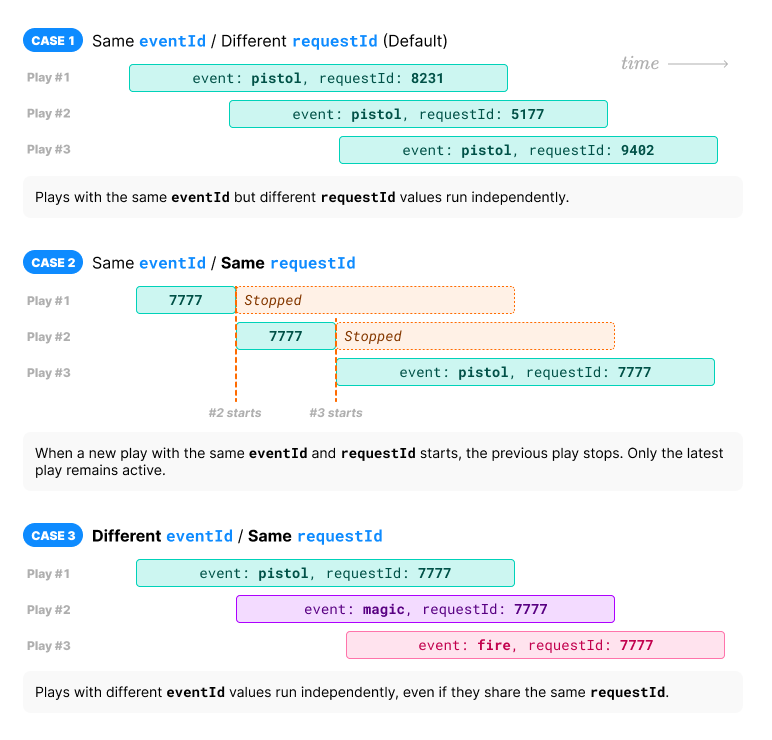
Returns
Request ID. You can use the request ID to stop the haptic. It returns -1 if the return fails.
However, when connected to the Hub, failed calls do not return -1 because the Hub does not provide a return value.
Example
using Bhaptics.SDK2;

public class Example : MonoBehaviour
{
    private void OnShoot()
    {
        // Assume the event name is "shootpistol"

        // BASIC USAGE
        BhapticsLibrary.Play(BhapticsEvent.SHOOTPISTOL);
        // or
        BhapticsLibrary.Play("shootpistol");

        // ADVANCED USAGE
        BhapticsLibrary.Play(
            BhapticsEvent.SHOOTPISTOL, // Haptic name
            0,      // Playback start position (millisecond)
            1.0f,   // Haptic intensity
            1.0f,   // Haptic duration
            20.0f,  // Rotate haptic around global Vector3.up (0f - 360f)
            0.3f    // Move haptic up or down (-0.5f - 0.5f)
        );

        // CUSTOM REQUEST ID
        BhapticsLibrary.Play(BhapticsEvent.SHOOTPISTOL, requestId: 1001);
    }
}
PlayParam
public static int PlayParam(string eventId, float intensity = 1.0f, float duration = 1.0f, float angleX = 0.0f, float offsetY = 0.0f, int requestId = -1);
Play haptic event, with adjusting the strength, duration, and direction of the haptic.
Parameters
string eventId: Name of haptic event which you want to play.float intensity: The haptic intensity is multiplied by this value.float duration: The haptic duration is multiplied by this value.float angleX: Rotate haptic counterclockwise around the globalVector3.up. Valid range is: [0.0f-360.0f]float offsetY: Move haptic up or down. Valid range is: [-0.5f-0.5f]int requestId: Specify a request ID instead of using a random one. Valid values are0or greater. If omitted or negative, a random ID is assigned.Reusing a request ID
Normally, if you play a haptic while another haptic is still playing, the new playback runs on top of the current one. However, if you play it with the same
eventIdandrequestIdas the current haptic, the current playback stops and the new one starts. This makes each haptic feel more distinct and prevents haptics from stacking up when played repeatedly at short intervals.
Returns
Request ID. You can use the request ID to stop the haptic. It returns -1 if the return fails.
However, when connected to the Hub, failed calls do not return -1 because the Hub does not provide a return value.
Example
using Bhaptics.SDK2;

public class Example : MonoBehaviour
{
    private void OnShoot()
    {
        BhapticsLibrary.PlayParam(
            BhapticsEvent.SHOOTPISTOL, // Haptic name
            1.0f,   // Haptic intensity
            1.0f,   // Haptic duration
            20.0f,  // Rotate haptic around global Vector3.up (0f - 360f)
            0.3f    // Move haptic up or down (-0.5f - 0.5f)
        );
    }
}
PlayAngle
public static int PlayAngle(string eventId, float angleX, float offsetY);
Play haptic event, with adjusting the direction of the haptic. This is a convenience wrapper around PlayParam with intensity and duration fixed at 1.0f.
Parameters
string eventId: Name of haptic event which you want to play.float angleX: Rotate haptic counterclockwise around the globalVector3.up. Valid range is: [0.0f-360.0f]float offsetY: Move haptic up or down. Valid range is: [-0.5f-0.5f]
Returns
Request ID. You can use the request ID to stop the haptic. It returns -1 if the return fails.
However, when connected to the Hub, failed calls do not return -1 because the Hub does not provide a return value.
PlayLoop
public static int PlayLoop(
    string eventId,
    float intensity = 1.0f,
    float duration = 1.0f,
    float angleX = 0.0f,
    float offsetY = 0.0f,
    int interval = 200,
    int maxCount = 999999
);
Play the haptic repeatedly. Additionally, like the function PlayHapticWithOption, you can adjust the strength, duration, and direction of the haptic.
Parameters
string eventId: Name of haptic event which you want to play.float intensity: The haptic intensity is multiplied by this value.float duration: The haptic duration is multiplied by this value.float angleX: Rotate haptic counterclockwise around the globalVector3.up. Valid range is: [0.0f-360.0f]float offsetY: Move haptic up or down. Valid range is: [-0.5f-0.5f]int interval: The time interval between loops, measured in milliseconds.int maxCount: The number of loops.
Returns
Request ID. You can use the request ID to stop the haptic. It returns -1 if the return fails.
However, when connected to the Hub, failed calls do not return -1 because the Hub does not provide a return value.
Example
using Bhaptics.SDK2;

public class Example : MonoBehaviour
{
    private void OnShoot()
    {
        BhapticsLibrary.PlayLoop(
            BhapticsEvent.SHOOTPISTOL, // Haptic name
            1.0f,   // Haptic intensity
            1.0f,   // Haptic duration
            20.0f,  // Rotate haptic around global Vector3.up (0f - 360f)
            0.3f,   // Move haptic up or down (-0.5f - 0.5f)
            200,    // Loop interval time (millisecond)
            999999  // Loop count
        );
    }
}
PlayLoopOnly
public static int PlayLoopOnly(string eventId, int interval = 200, int maxCount = 999999);
Play the haptic repeatedly. This is a convenience wrapper around PlayLoop with intensity and duration fixed at 1.0f and no directional adjustment.
Parameters
string eventId: Name of haptic event which you want to play.int interval: The time interval between loops, measured in milliseconds.int maxCount: The number of loops.
Returns
Request ID. You can use the request ID to stop the haptic. It returns -1 if the return fails.
However, when connected to the Hub, failed calls do not return -1 because the Hub does not provide a return value.
Static Functions — Play Haptic Directly
If you want to play haptics without creating a new event, use these functions.
PlayMotors
public static int PlayMotors(int position, int[] motors, int durationMillis);
Play haptic feedback on the specific haptic actuator. You can use this function without creating an event.
Parameters
int position: Type of haptic device. For more information, please refer here.Value Device Same as... Motors Count 0TactSuit Pro PositionType.Vest32 1TactSleeve(Left) PositionType.ForearmL3 2TactSleeve(Right) PositionType.ForearmR3 3TactVisor PositionType.Head4 4Tactosy for Hands(Left) PositionType.HandL3 5Tactosy for Hands(Right) PositionType.HandR3 6Tactosy for Feet(Left) PositionType.FootL3 7Tactosy for Feet(Right) PositionType.FootR3 8TactGlove(Left) PositionType.GloveL8 9TactGlove(Right) PositionType.GloveR8 int[] motors: Assign the length of the array by the number of motors for device. Values in the array means motors' intensity. Valid range for each value in the array is: [0-100]int durationMillis: The duration of haptic, measured in millisecond. Greater than or equal to100is recommended.
Returns
Request ID. You can use the request ID to stop the haptic. It returns -1 if the return fails.
However, when connected to the Hub, failed calls do not return -1 because the Hub does not provide a return value.
Example
using Bhaptics.SDK2;

public class Example : MonoBehaviour
{
    private void OnCall()
    {
        // TactSuit Pro has 32 motors, so length of array should be 32 too.
        int[] MotorValueArray = new int[] {
            50, 40, 30, 20, 10, 50, 40, 30,
            50, 40, 30, 20, 10, 50, 40, 30,
            50, 40, 30, 20, 10, 50, 40, 30,
            50, 40, 30, 20, 10, 50, 40, 30,
        };

        BhapticsLibrary.PlayMotors(
            (int)PositionType.Vest, // Device type
            MotorValueArray,        // Haptic intensities
            500                     // Haptic duration (millisecond)
        );
    }
}
PlayWaveform
public static int PlayWaveform(
    PositionType positionType,
    int[] motorValues,
    GlovePlayTime[] playTimeValues,
    GloveShapeValue[] shapeValues,
    int frequency = 80,
    int repeatCount = 0
);
TactGlove Only. Play haptics in TactGlove. Unlike using PlayMotors, you can finely adjust haptic duration and vibration intensity changes. This allows for even finer expression of haptic feedback.
Each array (motorValues, playTimeValues, shapeValues) must have six elements for TactGlove DK2 or eight elements for TactGlove DK3, and all three arrays must have the same length. Any other length returns -1.
Parameters
-
PositionType positionType: Type of haptic device.Value Device Same as… PositionType.GloveLTactGlove(Left) 8PositionType.GloveRTactGlove(Right) 9 -
int[] motorValues: An array representing the intensity of each motor. Its length must match the number of motors in the TactGlove: six (TactGlove DK2) or eight (TactGlove DK3). The palm motors at array indices6and7(in the table below) exist on DK3 only. Valid range for each value in the array is: [0-100]Array Index Motor is positioned at… 0Tip of the thumb 1Tip of the index finger 2Tip of the middle finger 3Tip of the ring finger 4Tip of the little finger 5On the wrist 6On the palm (thumb side) 7On the palm (little finger side) -
GlovePlayTime[] playTimeValues: An array with the same length asmotorValues(six for DK2, eight for DK3), each representing a time interval for actuation, with time defined usingGlovePlayTimeenums.Value Duration Same as… GlovePlayTime.NoneNone 0GlovePlayTime.FiveMS5ms 1GlovePlayTime.TenMS10ms 2GlovePlayTime.TwentyMS20ms 4GlovePlayTime.ThirtyMS30ms 6GlovePlayTime.FortyMS40ms 8 -
GloveShapeValue[] shapeValues: An array with the same length asmotorValues(six for DK2, eight for DK3), each representing the forms of haptic intensity changes over time, specified by theGloveShapeValueenums.Value Waveform Same as… GloveShapeValue.ConstantConstant intensity for the duration 0GloveShapeValue.DecreasingStarts at the specified intensity and decreases by half 1GloveShapeValue.IncreasingStarts at half of the specified intensity and increases to the specified one. 2[TactGlove DK3] On the DK3 glove, the wrist actuator (array index
5) is a voice-coil motor (VCM) and does not reflectshapeValues. The other seven motors apply the waveform shape the same as on DK2 gloves. -
int frequency: [TactGlove DK3 only] Vibration frequency in Hz of the DK3 glove's own actuators. The default is80. This affects only the DK3 glove itself and does not change the operating frequency of any other connected device. It has no effect on DK2 gloves or on the universal (non-Windows/macOS) path. Windows/macOS only. -
int repeatCount: Number of times to repeat the waveform, from1.0plays it once. Windows/macOS only.
Returns
Request ID. You can use the request ID to stop the haptic. It returns -1 if the return fails.
However, when connected to the Hub, failed calls do not return -1 because the Hub does not provide a return value.
Example
using Bhaptics.SDK2;

public class TestHaptic : MonoBehaviour
{
    public void OnCall()
    {
        int[] motorValues = new int[8] { 50, 80, 100, 0, 0, 0, 0, 0 };

        GlovePlayTime[] playTimeValues = new GlovePlayTime[8] {
            GlovePlayTime.FiveMS, GlovePlayTime.TwentyMS,
            GlovePlayTime.ThirtyMS, GlovePlayTime.None,
            GlovePlayTime.None, GlovePlayTime.None,
            GlovePlayTime.None, GlovePlayTime.None
        };

        GloveShapeValue[] shapeValues = new GloveShapeValue[8] {
            GloveShapeValue.Constant, GloveShapeValue.Decreasing,
            GloveShapeValue.Increasing, GloveShapeValue.Constant,
            GloveShapeValue.Constant, GloveShapeValue.Constant,
            GloveShapeValue.Constant, GloveShapeValue.Constant
        };

        BhapticsLibrary.PlayWaveform(
            PositionType.GloveL,    // Device Type
            motorValues,            // Intensities
            playTimeValues,         // Intervals
            shapeValues             // Intensity changing forms
        );
    }
}
PlayPath
public static int PlayPath(
    int position,
    float[] xValues,
    float[] yValues,
    int[] intensityValues,
    int duration
);
Play haptic around specific coordinates. Unlike PlayMotors function, which specifies the haptic intensity for each haptic actuator individually, this method specify the haptic intensity for particular coordinates.
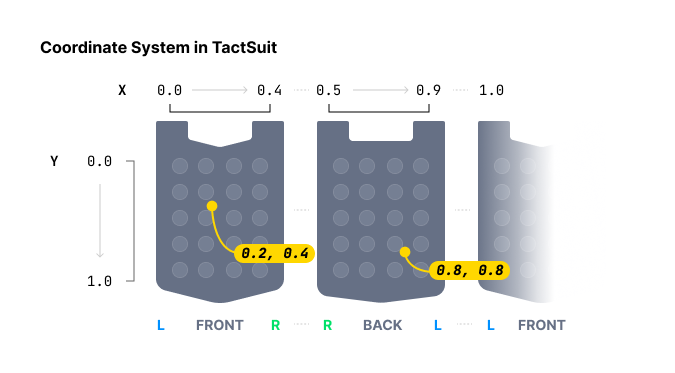
When specifying haptic position, PlayMotors offers discrete control, while PlayPath is more continuous. PlayMotors assigns intensity to individual actuators, whereas PlayPath allows intensity specification for specific coordinates (between 0 and 1 for both X and Y axis), causing nearby actuators to vibrate accordingly.
You can put multiple coordinates with multiple intensities. Note that all actuators around these coordinates in the array will activate simultaneously (at the same time), not sequentially. Moreover, the size of all arrays must be the same.
By continuously calling this function while gradually changing the values, you can achieve the effect of a moving haptic point.
[TactGlove DK3] PlayPath does not drive the wrist voice-coil motor (VCM) on a DK3 glove.
Parameters
int position: Type of haptic device.Value Device Same as... 0TactSuit Pro PositionType.Vest1TactSleeve(Left) PositionType.ForearmL2TactSleeve(Right) PositionType.ForearmR3TactVisor PositionType.Head4Tactosy for Hands(Left) PositionType.HandL5Tactosy for Hands(Right) PositionType.HandR6Tactosy for Feet(Left) PositionType.FootL7Tactosy for Feet(Right) PositionType.FootR8TactGlove(Left) PositionType.GloveL9TactGlove(Right) PositionType.GloveRfloat[] xValues: Assign X coordinate. Valid range for each value in the array is: [0.0f-1.0f]float[] yValues: Assign Y coordinate. Valid range for each value in the array is: [0.0f-1.0f]int[] intensityValues: Assign the length of the array by the number of coordinate. Values in the array means coordinates' intensity. Valid range for each value in the array is: [0-100]int duration: The duration of haptic, measured in millisecond. Greater than or equal to100is recommended.
Returns
Request ID. You can use the request ID to stop the haptic. It returns -1 if the return fails.
However, when connected to the Hub, failed calls do not return -1 because the Hub does not provide a return value.
Example
using Bhaptics.SDK2;

/* Assumption:
    - For TactSuit Pro
    - Coordinate with Intensity
    - (X: 0.1, Y: 0.2) Intensity 40
    - (X: 0.3, Y: 0.4) Intensity 80
    - (X: 0.5, Y: 0.6) Intensity 10
  - Duration 500ms(=0.5 second)
*/
public class TestHaptic : MonoBehaviour
{
    public void OnCall()
    {
        BhapticsLibrary.PlayPath(
            (int)PositionType.Vest,           // Device type
            new float[] { 0.1f, 0.3f, 0.5f }, // X Coordinates
            new float[] { 0.2f, 0.4f, 0.6f }, // Y Coordinates
            new int[] { 40, 80, 10 },         // Intensities
            500                               // Duration
        );
    }
}
Static Functions — Others
using Bhaptics.SDK2;

public class TestHaptic : MonoBehaviour
{
    public void OnCall()
    {
        int requestID = BhapticsLibrary.Play("TestHaptic");

        if (BhapticsLibrary.IsPlayingByEventId("TestHaptic"))
        {
            BhapticsLibrary.StopByEventId("TestHaptic");
        }

        if (BhapticsLibrary.IsPlayingByRequestId(requestID))
        {
            BhapticsLibrary.StopInt(requestID);
        }

        if (BhapticsLibrary.IsPlaying())
        {
            BhapticsLibrary.StopAll();
        }
    }
}
StopByEventId
public static bool StopByEventId(string eventId)
Stop the haptic event by Event ID. Returns whether the stop was successful.
StopInt
public static bool StopInt(int requestId)
Stop the Haptic Event by using the Request ID from the return of the function that executes the haptic. Returns whether the stop was successful.
StopAll
public static bool StopAll()
Stops all haptic currently playing. Returns whether the stop was successful.
IsPlaying
public static bool IsPlaying()
Check if any haptic is currently playing.
IsPlayingByEventId
public static bool IsPlayingByEventId(string eventId)
Check if the haptic event for this Event ID is currently playing.
IsPlayingByRequestId
public static bool IsPlayingByRequestId(int requestId)
Check if the haptic event for this Request ID is currently playing.
PauseByEventId
public static void PauseByEventId(string eventId)
Pauses an active haptic event. Use PauseByEventId(string eventId) to pause a specific haptic event. The paused event can later be resumed using ResumeByEventId(string eventId).
ResumeByEventId
public static void ResumeByEventId(string eventId)
Resumes a paused haptic event. Use ResumeByEventId(string eventId) to resume playback from the position it was paused at.